Loading
Loading


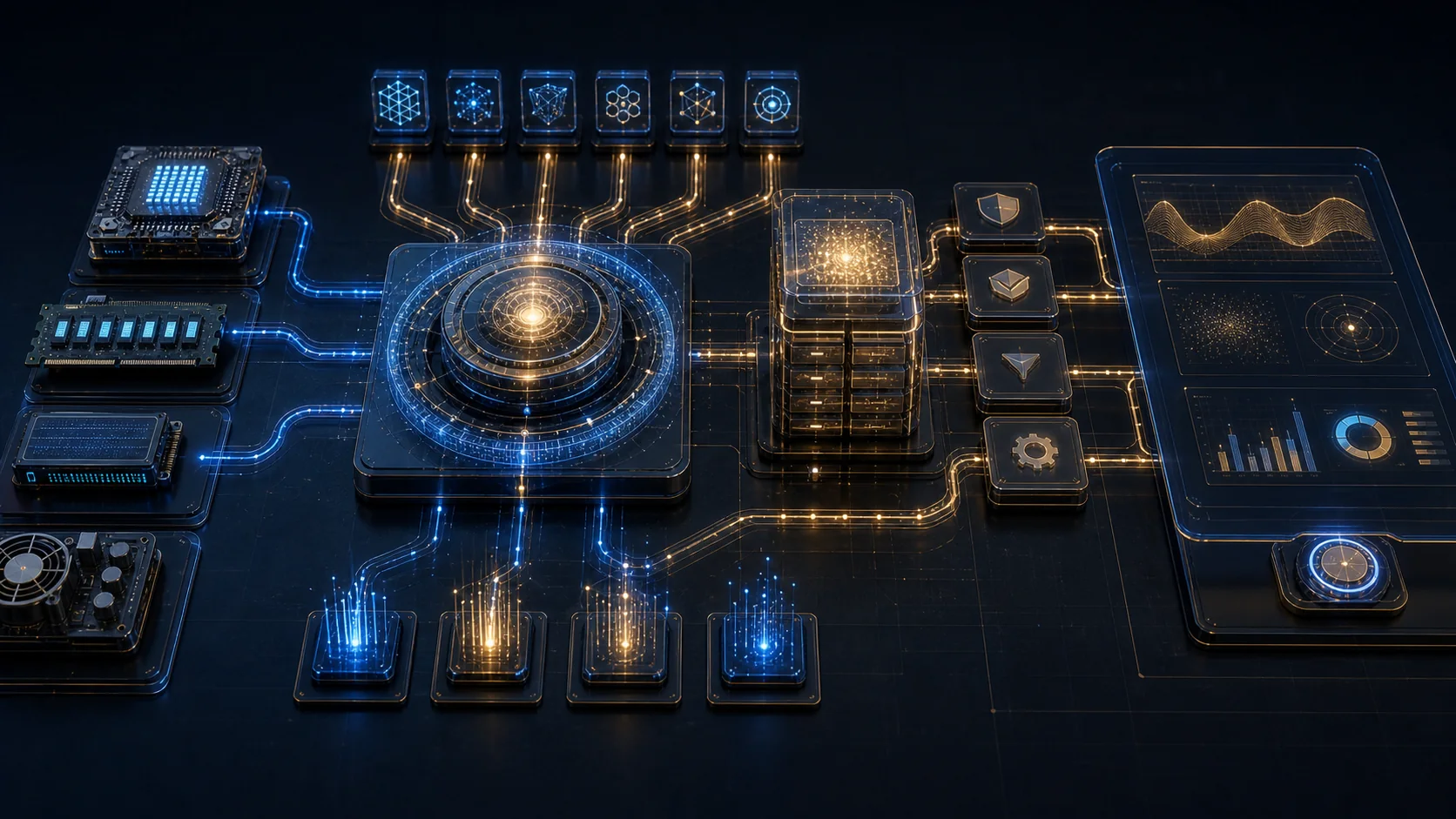
To understand an AI Operating System, it helps to think about what a conventional operating system actually does. Your computer's OS manages all the hardware and software resources available to it. It decides what runs, when, in what order, and with access to which data. Without it, your applications cannot function — they have no coordination layer, no memory, no coherent logic connecting them. The OS does not replace every application. It makes those applications usable together. It allocates resources, protects access, stores state, responds to events, and gives the user a single interface through which the machine becomes manageable. Now translate that to a business. Your people are the processing power. Your workflows are the applications. Your data — CRM records, emails, documents, reports, dashboards, customer histories, operational manuals — is the file system. Your management rituals are the interface. But most organisations have no operating layer. Every application, team, function, and workflow runs in partial isolation. Sales has one version of the customer. Operations has another. Leadership receives a summary after the fact. The person who knows why a decision was made is usually the person who made it, and if they are unavailable, the business loses context. An AI Operating System is that coordination layer. It sits above your existing tools and teams and provides the intelligence, memory, and execution logic that connects them. In the computer analogy, the orchestrator agent is the kernel: the part that decides what should happen next and which resource should handle it. Specialist agents are the applications: each one handles a defined function such as lead qualification, content production, data analysis, reporting, customer service, proposal generation, or operational monitoring. The memory layer is the file system: it stores organisational knowledge in a way the system can retrieve and use. The dashboard is the graphical interface: it shows what is happening, what needs approval, and where performance is changing. The practical consequence is simple: the business stops relying on manual coordination as its default operating model. Instead of people asking, chasing, copying, retyping, summarising, and remembering, the system observes, routes, drafts, escalates, and records. That does not remove human judgement. It protects it. People spend less time moving information from one place to another and more time making the decisions only humans should make.

I want to be direct about this, because there is a great deal of noise in this space. An AI OS is not a chatbot. A chatbot waits to be asked a question and responds. An AI OS proactively monitors your operations, executes tasks, and surfaces insights without waiting for a prompt. A chatbot is a conversational endpoint. An AI OS is an operational architecture. It is not an automation template. Tools like Zapier and Make are excellent for connecting applications, and I use lighter automation tools where they are the right fit. But traditional automation follows fixed rules: if this happens, do that. It is powerful, but brittle. The moment a situation falls outside the expected pattern, the workflow either fails silently or needs a human to rescue it. An AI OS can interpret context, route exceptions, request human approval, and adapt its next action within defined boundaries. It is not a plugin. It is not a single-purpose tool that performs one isolated function. It is a system designed to function as the operational intelligence layer of your organisation. That distinction matters because the commercial value is not in a novelty interface. The value is in coordinated execution, observable performance, and the removal of operational drag from people who should be doing higher-value work. It is also not an excuse to automate recklessly. I do not believe in handing sensitive business decisions to opaque systems with no audit trail. Every serious AI OS needs permissions, human checkpoints, escalation paths, and clear logs. The point is not to pretend the business can run without people. The point is to give the business an intelligent execution layer that makes people faster, clearer, and less buried in avoidable manual work.

A well-built AI OS has six layers. Layer 1 is the orchestrator. This is the master agent. It understands your business goals, monitors the state of your operations in real time, and delegates to specialist agents based on what it observes. The orchestrator is not there to do every task itself. It is there to decide which task matters, which agent should handle it, what information is needed, and whether a human should approve the next step. Layer 2 is the specialist agent network. Each specialist agent handles a specific domain. One qualifies leads. One monitors operations. One produces content. One analyses data. One handles customer queries. One drafts proposals. One prepares executive briefings. They report back to the orchestrator, and they work from defined instructions, business rules, and permissions. This is where the system moves from generic AI to useful business infrastructure, because each agent is shaped around a real operational job. Layer 3 is memory and knowledge base. The AI OS holds your organisation's institutional memory — your processes, your preferences, your history, your documents, your previous decisions, your tone of voice, your product rules, your compliance requirements. This is what makes the system genuinely intelligent over time. Without memory, every AI interaction starts from zero. With memory, the system can understand context, avoid repeated questions, and apply the organisation's accumulated knowledge to new situations. Layer 4 is tool integration. This is the nervous system. The AI OS connects to your existing stack — CRM, email, calendar, data warehouse, communication tools, document stores, payment systems, support desks, analytics platforms, and internal APIs — and can read from and write to each of them with appropriate permissions. I do not build systems that require teams to abandon their current tools on day one. The stronger approach is to connect the tools that already hold business value and then add intelligence above them. Layer 5 is human oversight. This is not optional, and I build it into every system. At defined points, the AI OS surfaces decisions to a human operator before acting. A proposal may need approval before being sent. A high-value lead may need manual review before routing. An anomaly may need a director's sign-off before a response is triggered. This is where governance lives. Good AI infrastructure does not hide decisions. It exposes them clearly. Layer 6 is the control dashboard. This is a unified view of everything the system is doing. What tasks were completed. What decisions were made. What requires human attention. Which agents are active. Which workflows are producing measurable value. The dashboard turns the AI OS from invisible automation into accountable infrastructure. Always on. Always accurate.

Let me give you concrete examples drawn from the sectors I work in most. In insurance, an AI OS can automate lead qualification end-to-end. A prospective client fills out a form. The orchestrator routes the enquiry to a qualification agent, which assesses the lead against predefined criteria, scores it, and places it in the correct CRM pipeline — with a personalised follow-up email already drafted and awaiting human approval. From form submission to qualified pipeline entry: under eight seconds. The commercial value is not only speed. It is consistency. Every lead is assessed against the same logic, every high-intent enquiry is surfaced quickly, and the sales team spends less time sorting inboxes. In mining operations, an AI OS can monitor operational reporting in real time. Data from multiple sites flows into the system continuously. An anomaly detection agent flags deviations before they become incidents. An executive briefing agent compiles a daily summary and delivers it to the relevant director's inbox at 7:00 every morning — curated, formatted, and ready for decision-making. The goal is not to replace the operational team. The goal is to make sure leadership sees the right signal early enough to act. In media, an AI OS can run a content production pipeline that would otherwise require a team of five. A research agent monitors trends and competitor output. A drafting agent produces first-draft content briefs. An editorial agent applies house style and formatting guidelines. A scheduling agent slots content into the publication calendar. The editor reviews and approves. The system executes. This protects quality while increasing throughput, because the human editor is no longer doing the mechanical coordination work around every piece of content. For executive advisory practices, an AI OS can prepare daily intelligence briefings. It can monitor selected markets, legislation, client updates, competitor activity, and internal priorities, then produce a concise briefing that tells the executive what changed, why it matters, and what decision may be required. For service businesses, it can generate proposal drafts from discovery notes, case studies, pricing rules, and delivery constraints. For customer support teams, it can triage tickets, draft responses, escalate risk cases, and identify recurring product issues. The common pattern is not the sector. The common pattern is repeatable decision work that currently consumes senior human attention. That is where AI operating infrastructure becomes commercially meaningful.

My process has five stages, and every one of them matters. The first is Systems Discovery. I map your current operations in detail — your workflows, your bottlenecks, your data sources, your decision points, your current tools, your reporting habits, and the moments where work slows down because someone needs to chase, check, approve, or re-enter information. This becomes the blueprint. I cannot build the right system without understanding your specific operational reality, and I will not pretend otherwise. The second is Agent Architecture. Based on the discovery, I design the network. Which agents are needed. What each one handles. How they communicate. Which systems they can access. What they are allowed to decide. Where human oversight is essential. This is the most intellectually demanding stage, and it is where the quality of the final system is determined. A weak architecture produces a collection of clever demos. A strong architecture produces infrastructure the business can trust. The third is Integration & Tooling. I connect the agent network to your existing stack. The specific tools depend on your environment. For orchestration, I may use frameworks such as LangGraph or workflow systems such as n8n where they fit. For model access, I work with APIs from providers such as OpenAI and Anthropic, selected according to the task, cost profile, latency needs, and data sensitivity. For lighter integrations, tools such as Zapier can still play a role. For visibility, I often build custom Next.js dashboards so the client has a clear command centre rather than a hidden chain of automations. The fourth is Deployment & Testing. Every agent is stress-tested in a controlled environment before full activation. I look for failure modes, edge cases, unexpected inputs, poor confidence, permission errors, escalation gaps, and decision-making mistakes. The system goes live only when I am confident in its behaviour. A focused starter network can often be deployed in three to four weeks. A fuller AI OS with multiple agents, deeper integrations, and a custom dashboard usually takes six to twelve weeks depending on data readiness and integration complexity. The fifth is Handover & Ongoing Optimisation. You receive full documentation and an operational briefing. Your team knows what the system does, how to monitor it, where decisions are logged, and how to escalate when human judgement is needed. I also recommend quarterly optimisation reviews because the system should improve as your business evolves. New data sources become available. Processes change. The first agent cluster proves what should be automated next. The best AI OS does not remain static; it compounds.

This is not right for everyone, and I will tell you honestly if it is not right for you. It is right for you if you have a repeatable operational process that is currently consuming disproportionate human time. It is right for you if you have data — even basic data — about how your business operates. It is right for you if you have a growth ceiling that is caused by execution infrastructure rather than market demand. It is right for you if you are serious about making an infrastructure investment, not looking for a quick fix. If you are a founder who has validated the business and now needs to scale without proportional headcount growth, this is for you. You do not need another dashboard that creates more work. You need an execution layer that helps the business move faster without losing control. If you are an executive whose team is already at capacity, this is for you. You need intelligent delegation, better signal, and fewer meetings that exist only because information is scattered. If you are a solopreneur building something serious, this is for you. You may not have the budget or desire to hire a full operational team, but you still need leverage. The common thread is not company size. It is operational pressure. When the business has more opportunity than execution capacity, infrastructure becomes the multiplier.

The organisations that will define the next decade are not necessarily the ones with the biggest budgets or the most talented teams. They are the ones with the most intelligent infrastructure. They are the ones who built systems that compound in capability while their competitors are still routing emails manually. They are the ones who can make decisions from live intelligence, deploy repeatable processes quickly, and preserve institutional memory instead of losing it across inboxes, meetings, and staff turnover. An AI Operating System is how you build that infrastructure. Not eventually. Now. The advantage is not that AI can write a paragraph or answer a question. The advantage is that AI can become part of the operating layer of the business: watching, routing, drafting, escalating, recording, and improving the loops that keep the organisation moving. I am currently accepting a limited number of new engagements because this work requires close attention. If you are ready to explore what this would look like for your organisation, the first step is a 30-minute discovery call. No obligation. I assess fit before proposing anything. If this is not the right fit, I will tell you. If it is, we will map the first agent cluster and build from there. Apply for a Discovery Call: /start-project
Independent systems architect and digital strategist. I build digital infrastructure for organisations that cannot afford to get it wrong.