
Next.jsvsWordPress:WhytheTechnologyChoiceMattersMoreThanYouThink


Performance:TheNumbersTelltheStory
Next.js sites consistently outperform WordPress sites on Core Web Vitals — the performance metrics Google uses as ranking signals. A typical Next.js site achieves sub-second Largest Contentful Paint times, near-zero Cumulative Layout Shift, and fast Interaction to Next Paint scores. A typical WordPress site, loaded with plugins and a commercial theme, delivers LCP times of 3 to 6 seconds, measurable layout shift from dynamically loaded elements, and sluggish interactivity from render-blocking JavaScript. These are not marginal differences. They are differences that directly impact search rankings, user experience, and conversion rates. Google has confirmed that Core Web Vitals are ranking factors, and the gap between a well-built Next.js site and a typical WordPress site is significant enough to affect your organic visibility.
SEOCapabilities
WordPress has robust SEO plugin ecosystems — Yoast, Rank Math, and others provide meta tag management, sitemap generation, and schema markup tools. These work adequately for basic SEO requirements. Next.js gives you direct control over every aspect of your SEO infrastructure. Server-side rendering ensures search engines see fully rendered content. The metadata API provides programmatic control over titles, descriptions, canonical tags, and structured data. Static generation produces pages that load instantly. And the absence of plugin bloat means your technical SEO score starts from a higher baseline. For basic SEO needs, WordPress is sufficient. For competitive SEO where marginal gains matter, Next.js provides advantages that are difficult to replicate within the WordPress ecosystem.

Security
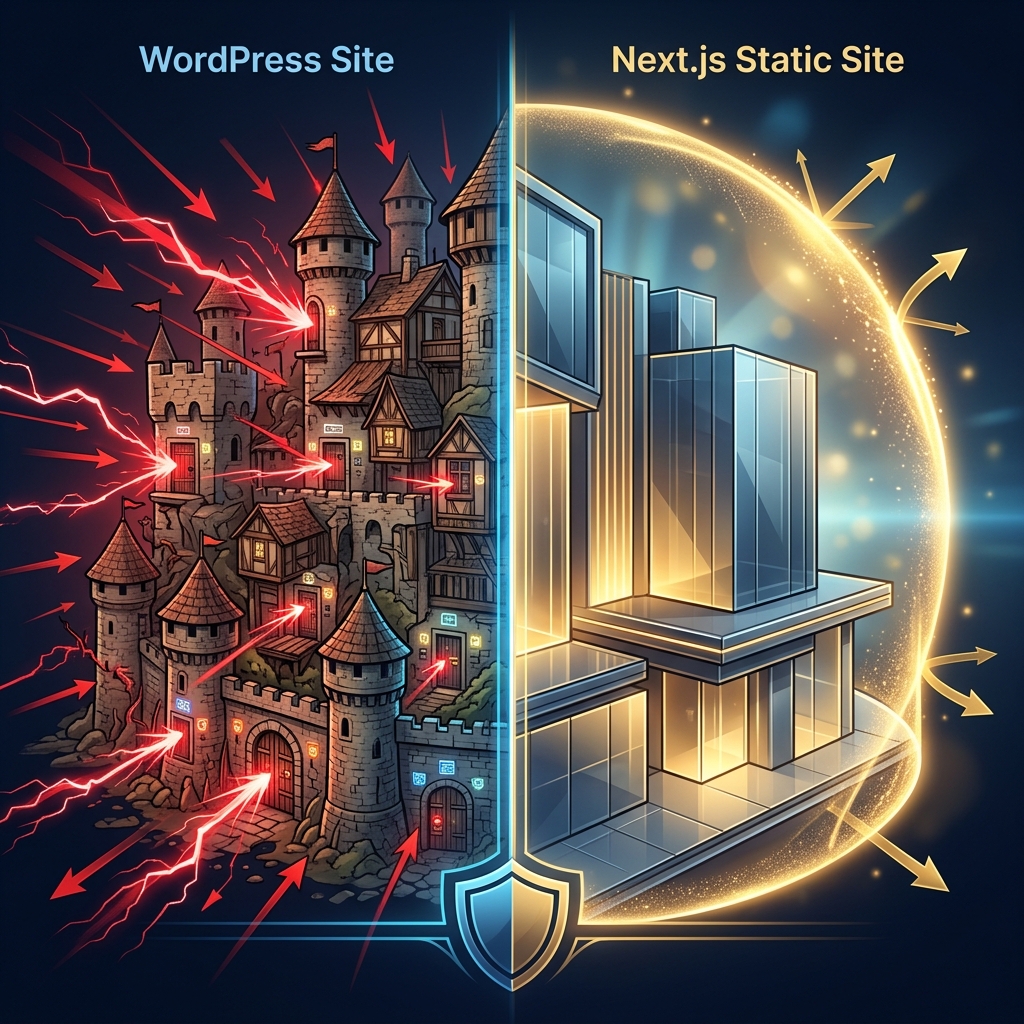
WordPress powers roughly 40 per cent of the web, which makes it the largest target for automated attacks. Plugin vulnerabilities, theme vulnerabilities, and brute-force login attempts are constant realities for WordPress site owners. Maintaining security requires regular updates, security plugins, and ongoing vigilance. Next.js sites deployed on modern platforms like Cloudflare or Vercel have a fundamentally different security profile. There is no admin panel to attack, no database to inject, and no plugins to exploit. The attack surface is dramatically smaller, and the hosting infrastructure provides enterprise-grade security by default. For businesses handling sensitive client data, this difference in security posture is not trivial.
TotalCostofOwnership
The initial cost of a WordPress website is typically lower than a Next.js build. But total cost of ownership tells a different story. WordPress requires ongoing hosting costs that scale poorly, regular plugin and theme updates, security monitoring and patch management, periodic performance optimisation as plugins accumulate, and eventual rebuilds when the plugin ecosystem creates conflicts. A Next.js site deployed on Cloudflare Pages or Vercel has minimal hosting costs, no plugin maintenance, inherent security, and a codebase that remains performant over time because it does not accumulate third-party dependencies. Over a three-year period, the total cost of ownership is often comparable — and the Next.js site delivers superior performance throughout.
WhenWordPressStillMakesSense
WordPress remains the right choice in specific scenarios: when your team needs to manage content frequently without developer involvement, when your budget genuinely cannot support custom development, when your site requires specific functionality only available through WordPress plugins, or when your SEO competition is modest enough that WordPress performance limitations do not impact your rankings. I am not anti-WordPress. I have managed WordPress sites professionally. But for businesses that need competitive search performance, fast load times, and robust security, Next.js is objectively the stronger foundation in 2026.
MakingtheDecision
The technology choice should be driven by your strategic requirements, not by what your developer is most comfortable building with. If you need a content-heavy site managed by non-technical staff with modest SEO requirements, WordPress can work well. If you need a high-performance digital platform that ranks competitively, loads instantly, and scales without accumulating technical debt, Next.js is the better foundation. I build exclusively on Next.js because the performance, security, and SEO advantages align with what my clients need: digital infrastructure that generates measurable results. If you are evaluating this decision for your business, I am happy to discuss the specifics of your situation.
Whitemore Ngwira aka N.White
Independent systems architect and digital strategist. I build digital infrastructure for organisations that cannot afford to get it wrong.