
AIAutomationinSouthAfricanBusiness:WhatIsPossibleRightNow

CRMAutomationThatActuallyWorks
The most immediately impactful AI automation for most South African businesses is CRM pipeline automation. If your sales team is manually updating deal stages, sending follow-up emails, and tracking lead status in spreadsheets, you are burning hours of productive time on tasks that should be automated. I build CRM automation systems that automatically score and prioritise incoming leads based on behaviour signals, trigger personalised follow-up sequences based on lead actions and engagement patterns, update deal stages automatically based on defined criteria, alert sales teams when high-value leads show buying signals, and generate pipeline reports without manual data entry. For a typical South African service business, this automation saves between 15 and 25 hours of administrative time per week. That is time your sales team can spend having conversations with qualified prospects instead of updating spreadsheets.

WorkflowAutomationAcrossOperations
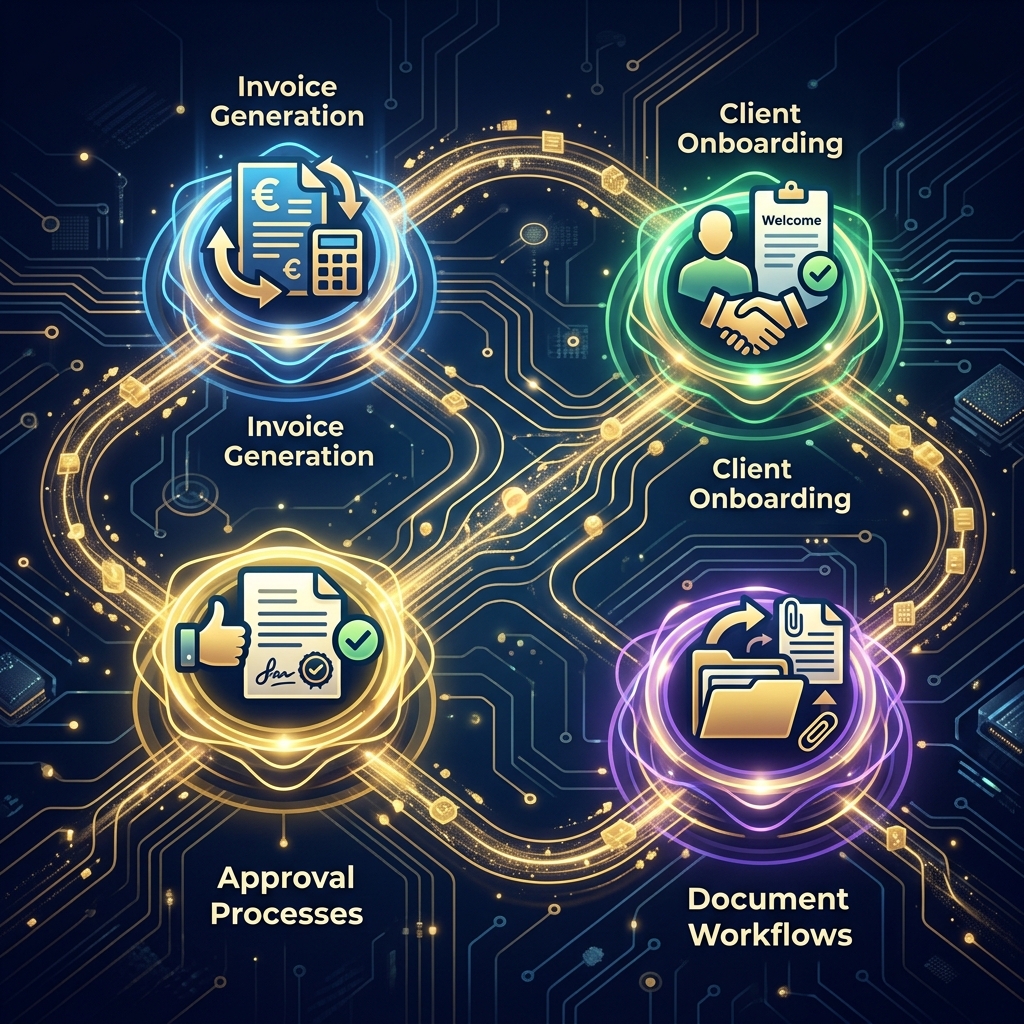
Beyond CRM, operational workflow automation is where South African businesses can achieve the most significant efficiency gains. Common workflows I automate include client onboarding processes that previously required multiple manual steps, invoice generation and payment follow-up sequences, project status reporting and stakeholder communication, document generation from templates based on CRM data, and internal approval processes for proposals, budgets, and procurement. The key principle is identifying repetitive, rule-based tasks that currently require human attention but not human judgement. These tasks are ideal automation candidates. They consume significant cumulative time, they are prone to human error, and they do not benefit from human creativity or strategic thinking.

IntelligentLeadGeneration
AI-powered lead generation systems represent a significant opportunity for South African businesses that rely on inbound enquiries. These systems combine website analytics, CRM data, and behavioural signals to identify and nurture potential clients more effectively than traditional marketing alone. In practice, this means chatbots that qualify visitors and capture contact information intelligently, lead scoring models that learn which visitor behaviours predict conversion, automated nurture campaigns that adapt content based on prospect engagement, and real-time alerts when target accounts visit your website. I have implemented these systems for several South African businesses this year, and the impact on lead quality and conversion rates has been substantial. The technology is mature, the implementation is straightforward, and the returns are measurable within the first quarter.
WhatItActuallyCosts
One of the most common misconceptions about AI automation in South Africa is that it requires enterprise-level budgets. This was true five years ago. It is not true today. For most small to mid-sized businesses, a comprehensive CRM and workflow automation implementation costs between R30,000 and R120,000 depending on complexity, with monthly operational costs of R2,000 to R8,000 for the platforms and integrations required. The return on investment typically materialises within 60 to 90 days through time savings, improved lead conversion, and reduced administrative overhead. For larger organisations, enterprise automation projects carry higher implementation costs but proportionally larger returns. The key is starting with high-impact, low-complexity automations and expanding systematically based on results.
WhatIsNotReadyYet
Honesty requires acknowledging what AI automation cannot reliably do for South African businesses today. Fully autonomous content creation without human oversight still produces output that lacks genuine expertise and brand voice consistency. Complex strategic decision-making cannot be delegated to AI systems without significant risk. And any AI system that claims to replace human relationship management in high-value B2B contexts is overselling its capabilities. The most effective approach is augmentation: using AI to handle the repetitive, data-intensive, and time-consuming aspects of your operations whilst keeping human judgement, creativity, and relationship skills at the centre of your business. This hybrid model delivers the best results and avoids the pitfalls of over-automation.
WheretoStart
If you are a South African business considering AI automation, start with your biggest operational bottleneck. Where are your people spending time on repetitive tasks that do not require human judgement? That is your first automation target. I work with organisations across South Africa to identify, design, and implement AI automation systems that deliver measurable returns. Every engagement begins with a focused assessment of your current operations and the specific opportunities that automation can address. If you are ready to stop reading about AI and start implementing it, I am ready to build it.
Whitemore Ngwira aka N.White
Independent systems architect and digital strategist. I build digital infrastructure for organisations that cannot afford to get it wrong.